
Coral Springs Neighbors by Block
The strongest public view of a Coral Springs block comes from land records. The Broward County Property Appraiser's map displays parcel shapes and a selected-parcel table. Property cards distinguish the physical site from the owner's mailing address. Deeds document transfers. Voter information and association contacts sit behind different access rules, so neither should be blended into an unsupported household list.
| Official or community source | Block evidence | How to reach it |
|---|---|---|
| BCPA Web Map | Adjacent parcels, owner, situs, values, use, exemptions, sales | Free interactive map |
| BCPA property card | Owner of record, mailing and situs distinction, improvements | Free property search |
| Broward voter record | Public registration fields subject to protected-address rules | Individual verification or data request |
| Neighborhood Partnership Program | Registered association contact and community boundary | City Community Development request |
| Sunbiz association filing | Nonprofit status, registered agent, officers, filing images | Free state search |
An owner name is not the same as an occupant name. A matching homestead exemption and matching situs and mailing addresses can support an occupancy clue, but they do not identify each member of a household. Renters may not appear on the roll at all. Describe a person as the owner of record unless another reliable source supports a more specific claim.
Collect Coral Springs Neighbor Parcels
BCPA Web Map has a practical feature called Collect Parcels. Search the subject address, zoom until parcel boundaries are clear, and select the starting lot. The parcel panel can show the parcel ID, owner, situs address, legal description, millage and use codes, values, exemptions, recent sales, square footage, neighborhood, and effective age.
Choose Collect Parcels and click the shapes beside, behind, or across from the starting parcel. The selected rows can then be compared in one table. This is the closest verified official method for viewing Coral Springs neighbors around a single address. The map does not offer a confirmed automatic resident-radius report, and condominium or common-area parcels require extra care.
Map tip. BCPA instructs address searchers to omit compass directions and the street type when entering the street name.
Map a Coral Springs Neighbor Block
Keep the search radius small and reproducible. One address should lead to the lots that actually touch or face it, not to a loose list of people sharing a postal code. Save the query spelling and inspection date because the property roll and map are updated on their own schedules.
- Open BCPA Web Map and search by house number and the normalized street name.
- Select the subject parcel. Record its folio, situs address, legal description, owner, and use code.
- Use Collect Parcels on each adjacent shape. Compare owner names, situs addresses, values, uses, sales, and effective ages.
- Open individual property cards when mailing and situs addresses, improvements, or exemption clues need closer review.
- Turn on city-limit, ZIP, zoning, flood, subdivision, street, and parcel layers only when that context answers a defined question.
A parcel polygon maps ownership geography, not household makeup. For an inquiry that extends beyond the immediate block, use the Coral Springs street directory and its full named-road workflow.
Coral Springs Owners and Occupants
BCPA records contain several fields that can be read too broadly. The situs address identifies the land. The mailing address is used for owner correspondence. Homestead is an exemption clue tied to the property record, not proof of every person living there. A recent sale date shows a recorded transaction, not the date each occupant arrived.
- Parcel
- A mapped unit of land with a Broward folio and legal description.
- Situs address
- The physical location assigned to the parcel.
- Mailing address
- The destination used for owner correspondence, which may differ from the situs.
- Homestead
- A property-tax exemption clue that should not be expanded into a household roster.
Use exact labels when recording findings. “Owner of record” is supportable from BCPA. “Resident” needs another official match, such as lawful voter verification with the required identifying information. Even then, public sources do not disclose all household members.
Coral Springs Neighbor Voter Limits
The Broward individual voter lookup requires first name, last name, birth year, and house number. It returns a match or nonmatch with registration, precinct, district, and election information. That tool cannot browse a street or enumerate a block. It never shows ballot choices.
A separate public-data request may ask Broward Elections for an existing registration extract tied to precincts or addresses. Florida law keeps Social Security numbers, driver-license or state-ID numbers, signatures, and protected addresses confidential. The office may provide an existing file subject to suppression rules, but a requester cannot compel staff to create a new analytical neighbor directory.
Reach Broward Elections through its main office at 4650 NW 21st Avenue in Fort Lauderdale, weekdays 9 a.m. to 5 p.m., or call 954-357-VOTE. A Coral Springs satellite operates at Northwest Regional Library, 3151 North University Drive.
Coral Springs Neighborhood Associations
The city Neighborhood Partnership Program is the best official entry to the community layer. It registers active neighborhood, civic, and homeowners' associations. Coral Springs reports more than 130 formal partnerships and more than $1 million in improvements. Community Development can be reached at 954-344-1114.
Neighborhood Partnership Program
Ask for the active association list, a registered contact, or a known community boundary. The city does not publish a household roster.
Association itself
Request any voluntarily shared contact or member information under that group's rules. Private membership is not a city resident roll.
Florida Sunbiz
Confirm a nonprofit association entity, filing status, registered agent, officers, and available filing images.
A voluntary neighborhood association has no regulatory power. An HOA is mandatory for owners within the governed development and may enforce covenants and fees. Neither category proves who currently lives in each home.
Coral Springs Community Record Clues
The city's matching-grant application can identify an organization name, phone, email, mailing address, neighborhood location, directors, project dates, budget, and earlier grant history. Eligibility calls for an active city-registered association, a community at least five years old, and an improvement connected to and visible from a public road. The current program describes awards up to $5,000 with a full neighborhood match.
Those fields document an organization and its project. They do not create a directory of Coral Springs neighbors. A board address can be compared with Sunbiz, but a registered agent or director is not proof that all residents belong to the group.
Congregation, civic-club, and block-watch membership should not be inferred. Ask for a clearly public record tied to a lawful purpose, and preserve the custodian's description of what the record does and does not contain.
Official Coral Springs Neighbor Sources
Commercial neighbor tools compile many datasets and may merge people with similar names or stale addresses. An official source is narrower, but it identifies its custodian, update context, and field meaning. Use the official record that matches the question, then verify any name across an independent source.
| Source type | Strength | Limit |
|---|---|---|
| BCPA parcel and card | Current owner, land, situs, mailing, exemptions, sales | Owner is not every occupant |
| Election custodian | Registration and district fields under Florida law | Individual tool is not a block browser; protected data is withheld |
| City association record | Registered group and contact facts | No public member directory |
| Commercial compilation | May gather broad leads | Can be stale, blended, costly, and uncertified |
Keep an evidence log with the portal URL, search spelling, filter, date viewed, record identifier, and whether the result was an index or image. A negative online search means “not found with this query,” not “no record exists.”
Changing Coral Springs Neighbor Records
Broward announced a 26-month regional law-records-management rollout after an October 2025 agreement, with Coral Springs among later agencies eligible to join. The project concerns interagency records and data sharing. It did not promise a new public neighbor portal.
The Broward records-modernization release explains the regional project and schedule.
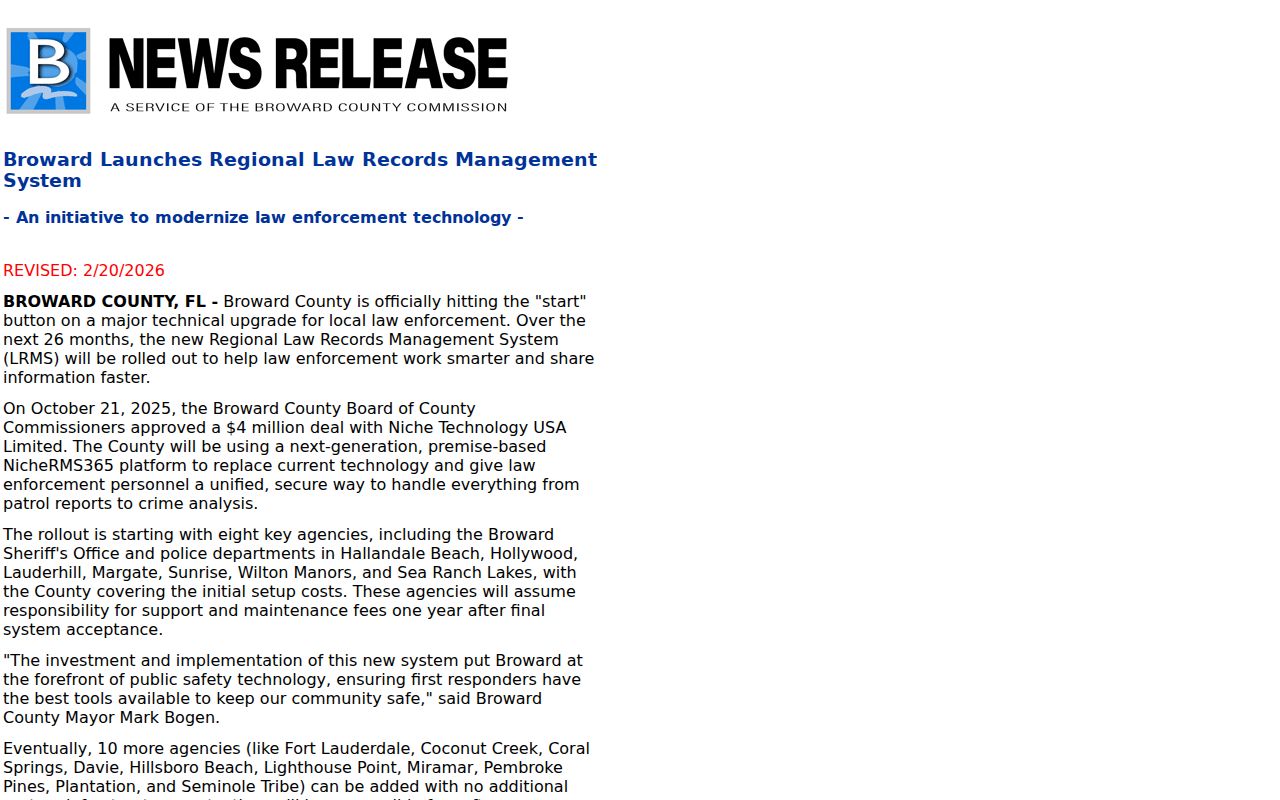
Changes in agency software can alter where a request begins without changing what is public. Check the current custodian page before filing, and use the city Clerk for Coral Springs municipal records.
Privacy for Coral Springs Neighbors
Public records cannot supply renter names, household composition, delivery customers, DMV addresses, or a complete list of people inside a home. Utility geography can identify the right water district, but customer accounts should not be treated as an open resident roll. Florida's Address Confidentiality Program gives qualifying victims a substitute address for public-agency use, and section 119.071 protects addresses for specified people and families.
Recorder processes can remove or block information when a statute provides protection. They do not create a general opt-out from lawful deeds or assessment rolls. When an expected address is absent, a confidentiality rule, update lag, spelling choice, or source limitation may explain the gap.
Lawful use. Use Coral Springs neighbor records for civic curiosity, reconnecting, or personal safety. Never use them to stalk, harass, threaten, or expose a protected person.
The Florida vital-record forms page illustrates a separate, eligibility-based records channel.
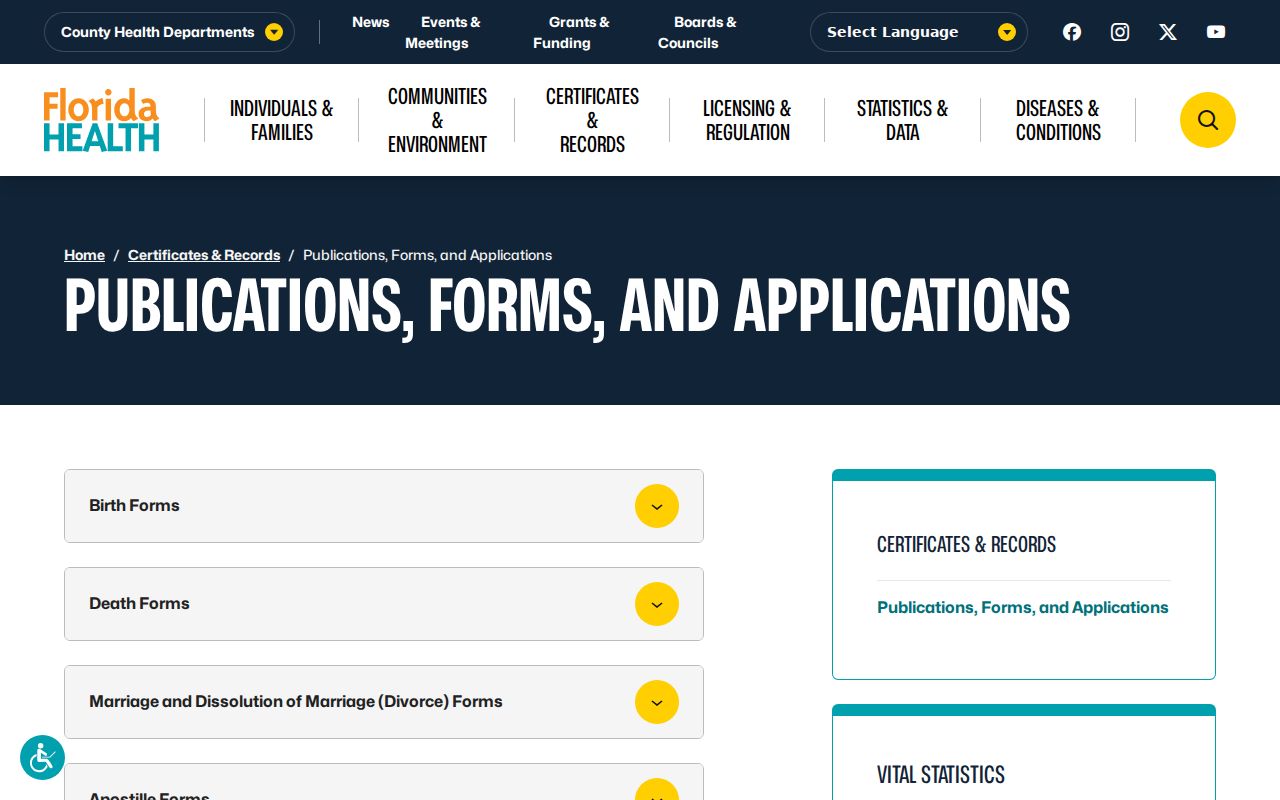
Vital applications are not a block lookup. Their identity, relationship, and certification rules show why official records must stay in their proper purpose and access channel.